Foreign invoice: withholding tax vs tax security (§43/§44)
A foreign invoice does not automatically mean “only VAT reverse charge”. For certain payments abroad, you may also need to handle withholding tax (§43) or tax security (§44). Below you’ll find a practical decision tree, the most common scenarios, and a checklist.
Ing. Marián Drozd
Tax advisor, 20+ years of practice
Note: This is a general approach. For specific contracts (especially software, SaaS and licences), the correct classification can be sensitive to contract wording and to the applicable double tax treaty.
1) First §16 (source of income), only then §43/§44
The key question is not “is it foreign?”, but: Is it a non-resident’s Slovak-source income under §16?
- For services, it concerns income from services provided in Slovakia, even without a permanent establishment.
- For industrial royalties, this may include payments for rights to use software and know‑how.
If the answer is “no”, §43/§44 typically does not apply. If the answer is “yes”, continue with the decision tree.
2) Decision tree: §43 vs §44 vs “no withholding”
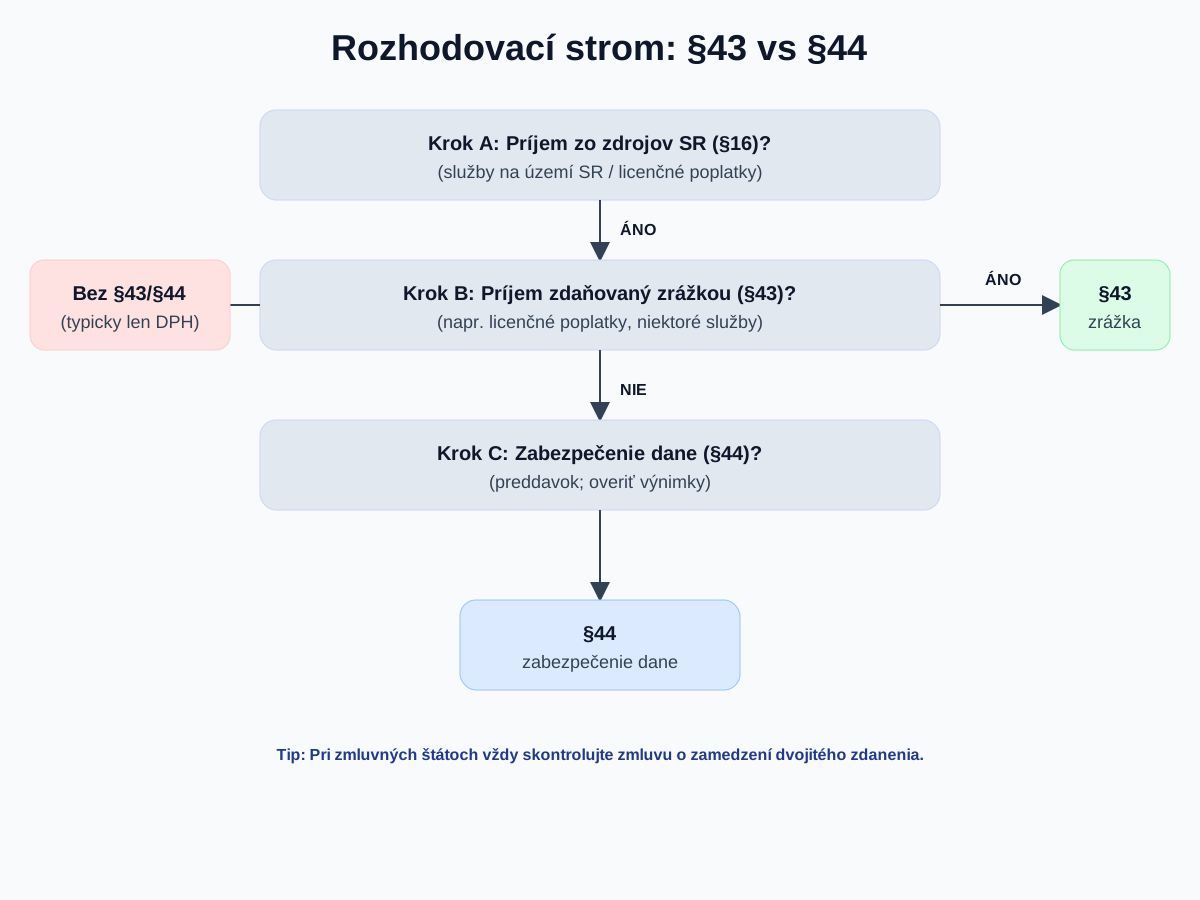
Step A: Is the recipient a non-resident and is it Slovak-source income (§16)?
- If no → §43/§44 does not apply.
- If yes → Step B.
Step B: Is it income that is taxed “at source” via withholding (§43)?
- If yes → you deal with withholding tax (§43).
- If no → Step C.
Step C: If it is not §43, §44 (tax security) may apply.
- §44 is an advance mechanism for income that is not collected via withholding.
- The law contains exemptions – always verify the specific situation.
3) Most common real‑world scenarios
Scenario 1: Advertising / marketing / consulting from a treaty state
For services provided by a non-resident in Slovakia, it is often decisive whether the supplier has a permanent establishment in Slovakia and how the double tax treaty treats the income.
Scenario 2: Licence / right to use software
Payments for the right to use software may qualify as royalties. In that case, withholding tax may apply, or a treaty rate under the relevant double tax treaty.
Scenario 3: SaaS / cloud / subscription
For online services, the key is whether it is a service or has a licence character. We recommend keeping documentation: contract, service description, rights granted and place of performance.
4) Rates and deadlines (most often forgotten)
§43 – withholding tax
- Standard rate 19% (35% for a non-cooperative jurisdiction).
- Possible to apply a treaty rate under a double tax treaty.
- Remittance is tied to payment; typically by the 15th of the following month.
§44 – tax security
- Advance mechanism, typically 19% (35% for a non-cooperative jurisdiction).
- Remittance typically by the 15th of the following month.
- The law contains exemptions – verify the specific case.
5) Non-cooperative jurisdiction = 35% rate
The 35% rate applies to income paid to taxpayers from non-cooperative jurisdictions. The list of cooperative jurisdictions is published and regularly updated by the Slovak Ministry of Finance.
6) 2‑minute checklist for every foreign invoice
- Supplier’s country of tax residence – EU/EEA or not?
- Is it Slovak-source income under §16 (service in Slovakia / licence / other)?
- Is the country cooperative or non-cooperative (35%)?
- Is there a double tax treaty and can it be applied?
- Do you have a certificate of tax residence (if needed)?
- Is it §43 (withholding) or §44 (security)?
- Date of payment/crediting (this drives the remittance deadline).
- Remit and notify by the 15th of the following month.
- Registration of the payer under §49a (if an obligation to withhold/secure arose).
7) FAQ
Do I have to withhold tax when I book the invoice?
No. The decisive moment is payment or crediting of the amount to the recipient.
Does withholding tax apply to advance payments as well?
Yes, if it is a payment related to income subject to withholding tax.
When does the 35% rate apply?
For income paid to taxpayers from non-cooperative jurisdictions.
8) Download: checklist spreadsheet
We prepared a simple spreadsheet where you tick the key questions for each foreign invoice and the remittance deadline is calculated automatically.